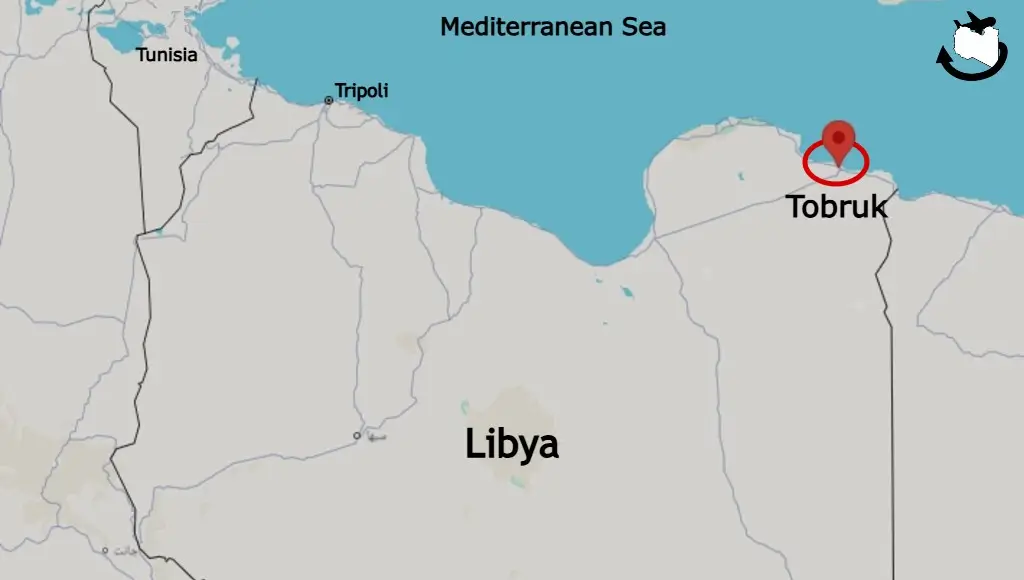
While the Libyan scene remains mired in political divisions, China is quietly but steadily expanding its presence in this Mediterranean country, in what appears to be part of a calculated plan to redraw trade and influence routes in North Africa.
A report published by “Sinosage” a platform specialized in tracking Chinese movements worldwide, highlighted the growing Chinese interest in Libya, particularly in the east of the country, where major projects are beginning to move from ideas on paper to actionable plans.
Tobruk is not just a coastal city
Many have long viewed Tobruk as a quiet Libyan city on the Mediterranean coast, but today it has earned a place on Beijing’s strategic agenda. Its geographical location alone makes it a focal point for international powers, as it is only a few maritime hours from Europe and boasts a natural deep-water port capable of accommodating large vessels that struggle to dock at famous European ports like Genoa and Piraeus.
China sees in Tobruk a valuable opportunity to transform it into a commercial and logistical hub serving the three continents, starting with a massive oil refinery planned at a cost of up to $10 billion, with a capacity to refine 500,000 barrels per day, focusing on European markets that have been searching for new and stable energy sources away from Russia for years.
Integrated Investments
The refinery project, while a top priority for China, is just one part of a broader plan. Through the development and expansion of Tobruk Port, along with the modernization of Al Adam Airport nearby — a former British Royal Air Force base — Beijing aims to build an integrated network of transportation and shipping connecting the Mediterranean to the heart of Africa and Asia, passing through the Suez Canal and the Red Sea.
These projects, according to multiple sources alongside “Sinosage,” are not merely commercial investments. In a region still suffering from political fragility, control over ports and airports also means direct influence over the movement of goods, energy, and even security dynamics.
Regional Connectivity Between Libya and Egypt
China knows well that Libya’s location alone is not enough, which is why plans to connect it to its surroundings are an essential part of the bigger picture. One of the most prominent projects involves laying a railway linking Tobruk and Benghazi to Marsa Matrouh in Egypt, eventually extending to the Red Sea, creating a land corridor stretching from North Africa deep into Asia.
These railway lines, expected to cost $20 billion, are not only for transporting goods but are part of a broader network aimed at facilitating the flow of Chinese goods to the African continent, in exchange for strategic African resources reaching the Libyan coasts and then global markets.
Diversifying the Chinese Presence to Include Telecommunications and Services
Beyond energy and transport, reports indicate that major Chinese companies, such as Huawei, have already begun enhancing their presence in eastern Libya, specifically in the telecommunications sector. Some of these projects have already entered into force in cooperation with local authorities, reflecting Beijing’s desire to establish a long-term foothold that goes beyond infrastructure to include technology and logistics services.
International Positions and the Impact of Chinese Movements
Although these developments have not yet been met with strong official reactions from Western capitals, observers in Europe and Washington are closely following the Libyan file with growing interest. Libya, which until recently was a scene of internal conflict and sharp divisions, is gradually turning into a new arena of international competition, with China entering with significant economic and strategic weight.
In contrast, the Western position toward Libya remains hesitant, especially with Europe preoccupied with the energy crisis and the war in Ukraine, giving Beijing more room to maneuver.
What is happening in Libya today goes beyond mere investments or infrastructure projects. The country, which played an important role in the battles of World War II, is once again becoming a strategic hub connecting Africa, Europe, and Asia. Amid the absence of a clear Western policy and American reluctance for direct involvement, China finds the path open to strengthen its position in a region that could become key to broader shifts in the global balance of power in the coming years.